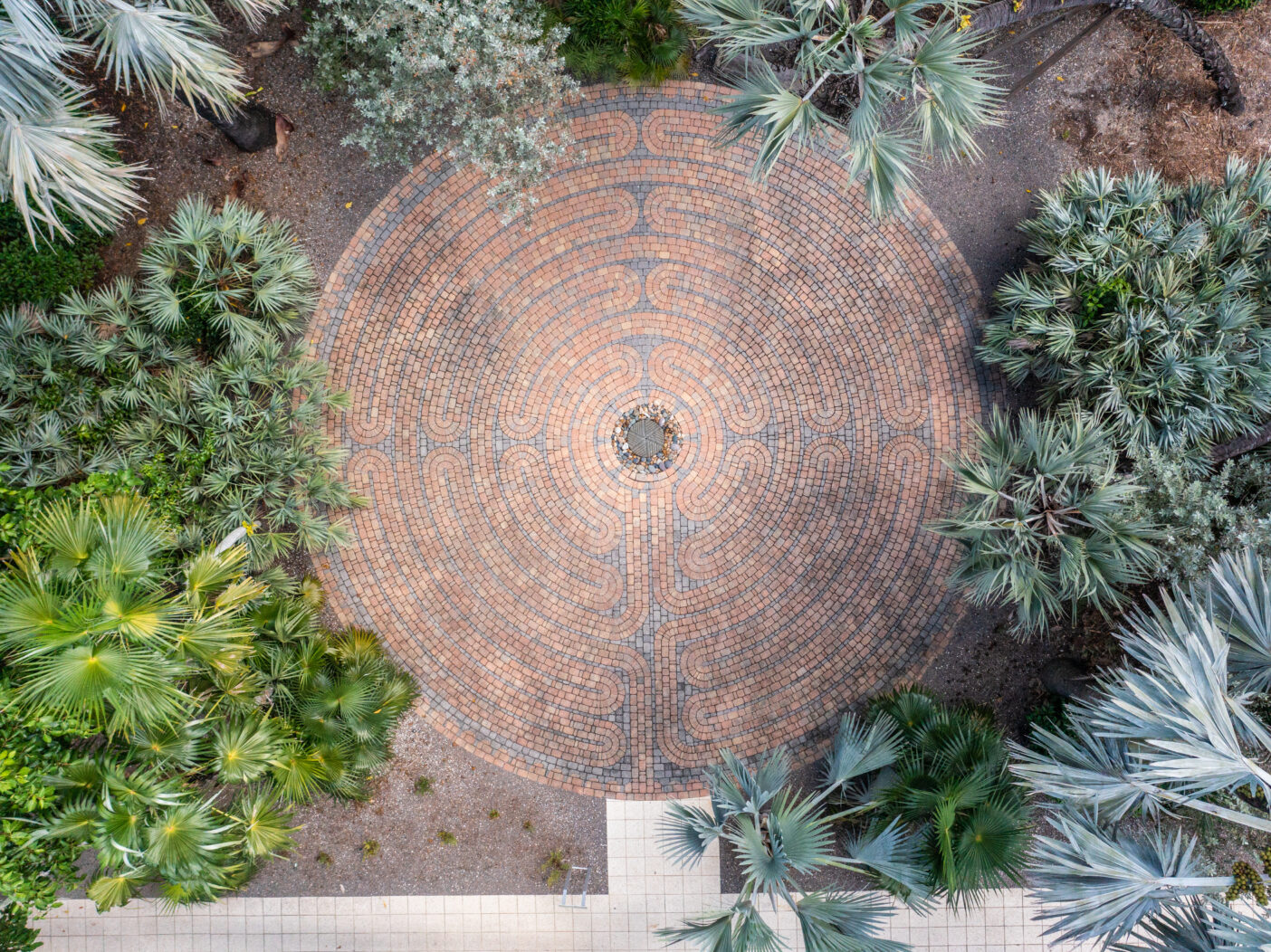
There’s a simple but important difference between a maze and a labyrinth: The goal of a maze is to find its center, while the goal of a labyrinth is to find your center. With one path in and the same path out, the labyrinth has become a recurring symbol in my life, one that ultimately led me back to Naples Botanical Garden, where I now work as an educator.
My journey with the Garden’s Jeannie Meg and Christopher B. Smith Labyrinth began in 2012, when I was 14. I was visiting with my mom when we stumbled upon it by chance. We walked the labyrinth together that day, and it soon became a shared tradition. Over the years, we’ve walked labyrinths wherever we travel, finding them through the Worldwide Labyrinth Locator, and often using them to mark milestones and transitions in our lives. Each walk is different, but the invitation is always the same: to be present and mindful, one step at a time. The quiet of labyrinth walks helped ground me through the busyness of my undergraduate work in environmental studies and guided me to graduate school, where I studied mindfulness. Today, it’s part of my work at Naples Botanical Garden, where I’m getting ready to introduce a new labyrinth program.

Labyrinths are not new; they have been used for more than 4,000 years across cultures as sacred, symbolic, and contemplative tools. They have served as metaphors for life’s journey, as paths of pilgrimage, and as spaces for healing and transformation. The Garden’s labyrinth is an 11-circuit medieval design modeled after the famous labyrinth at Chartres Cathedral in France, built in the early 13th century. Its spirals invite visitors into a centuries-old practice of reflection and discovery.
To use a labyrinth, one simply walks, meandering through its winding shape, entering and exiting from the same spot. The exercise is meant to cultivate mindfulness—a state of “paying attention in a particular way: on purpose, in the present moment, and non-judgmentally,” in the words of Jon Kabat-Zinn, founder of the Stress Reduction Clinic and Center for Mindfulness in Medicine at the University of Massachusetts Medical School. A labyrinth naturally cultivates this quality of attention. With no decisions to make or wrong turns to take, walkers are free to slow down, notice their breath, and simply be present.
One of the most powerful aspects of the Garden’s labyrinth is its setting, located amid lush, living plants. Too often, we experience what botanists call “plant indifference,” a habit of seeing a blur of green, rather than noticing individual plants and recognizing their unique character and importance. The labyrinth encourages us to observe the texture of bark, the curve of a leaf, the way sunlight shifts. We can carry this mindset with us as we explore the rest of the Garden and as we encounter the natural world in our day-to-day life. This simple act of noticing transforms indifference into awareness, reminding us that we do not live beside nature, but within it.
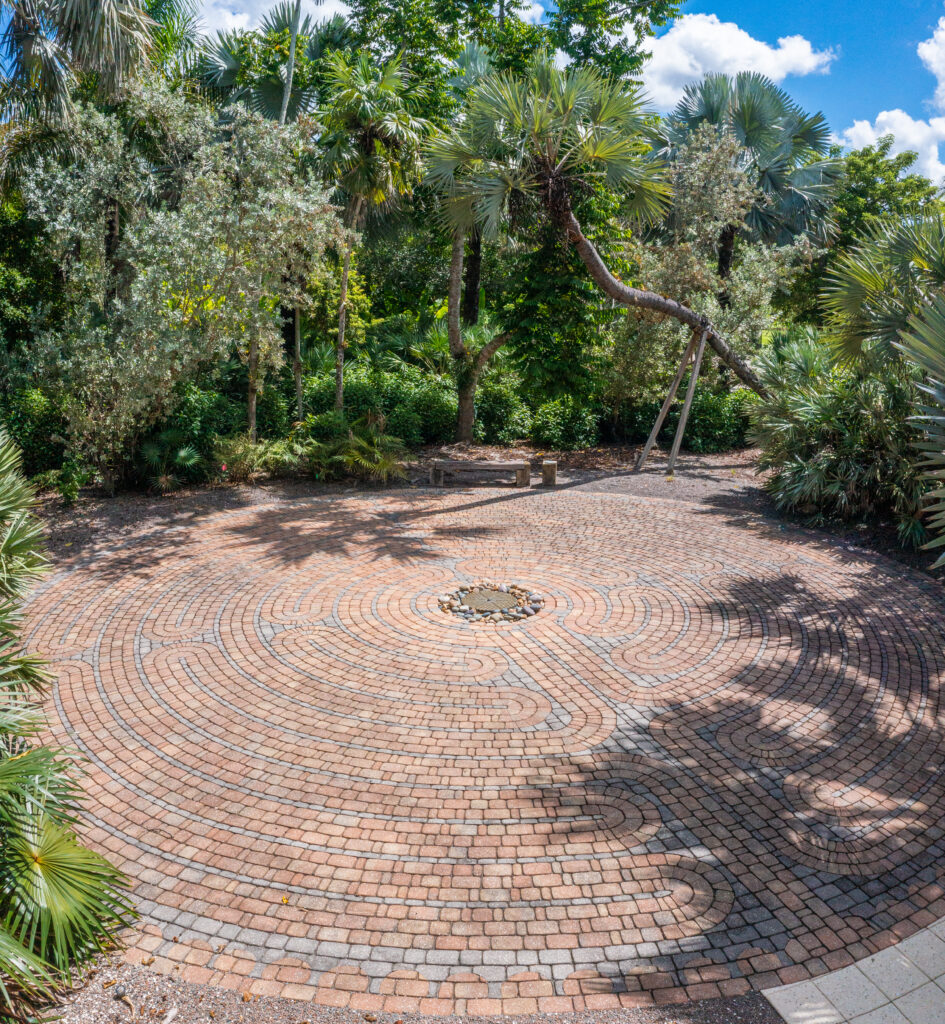
Walking the labyrinth is a form of “active relaxation.” Each step becomes an invitation to notice the sensations of your feet touching the ground, to soften your gaze toward the plants and sky around you, and to allow thoughts and feelings to come and go like clouds passing through an open sky.
The walk can be understood in three stages:
- Release: Let go of distractions as you enter the path.
- Receive: Pause in the center and be open to what arises.
- Return: Retrace the path back outward, integrating the experience into your life.
Some visitors walk in silence, others ponder a question or intention, and children often bring a sense of play and joy by running the path. There is no right way to walk the labyrinth; the experience belongs to the walker.
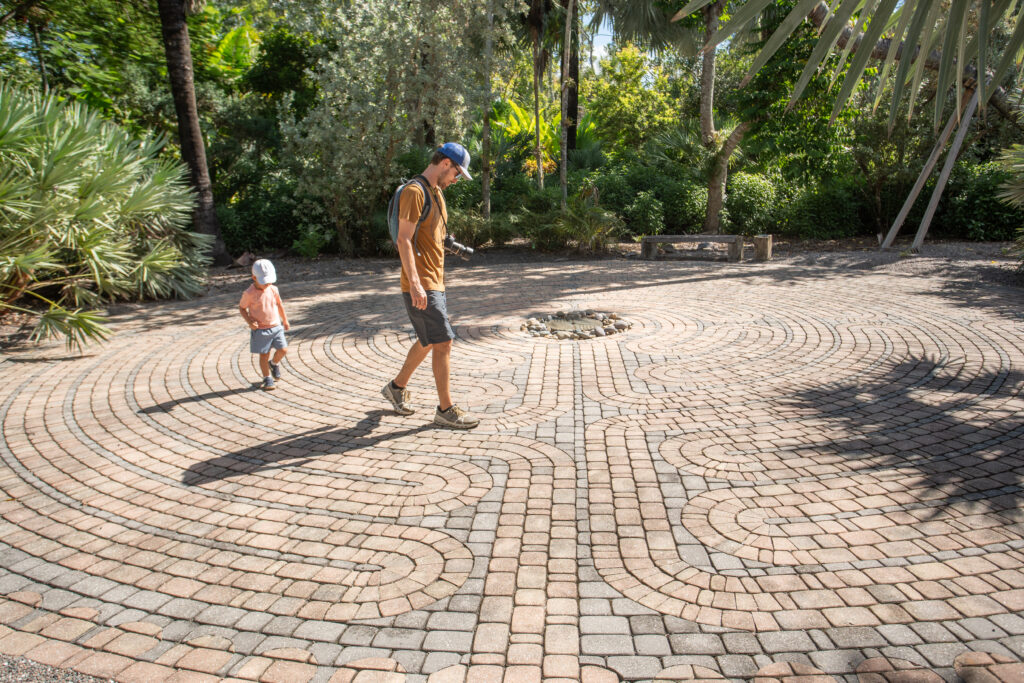
I’ve found that the labyrinth stays with me long after I’ve left it; I will check in with myself throughout the day, slow down, notice what’s around me, and ask myself: “Am I where my feet are?”
Today, in addition to earning a master’s in mindfulness and mental health studies, I am a Certified Veriditas Labyrinth Facilitator and serve on the Veriditas Council. Veriditas is a nonprofit organization with the mission to train and support labyrinth facilitators globally as well as offer programs and events to introduce and engage people with labyrinth walking as a pathway to personal and community enrichment, healing, and growth.
These experiences allow me to connect the labyrinth with the Garden. The labyrinth reminds us that the goal is not about arriving somewhere new—it’s about coming back to yourself, one step at a time.
To experience the labyrinth and learn more, join me at our new Dig Deeper program, Labyrinths: Pathways to Presence. The first will be held on October 28.