
The art exhibition on display in Kapnick Hall was born out of a question familiar to Floridians, the vast majority of whom were born elsewhere: Where is home?
That’s what Pseudomero, the artist behind Historias del aire y del suelo | Stories of Air and Soil, grappled with as he began an exploration of palm trees, one of two series showing through October 25.
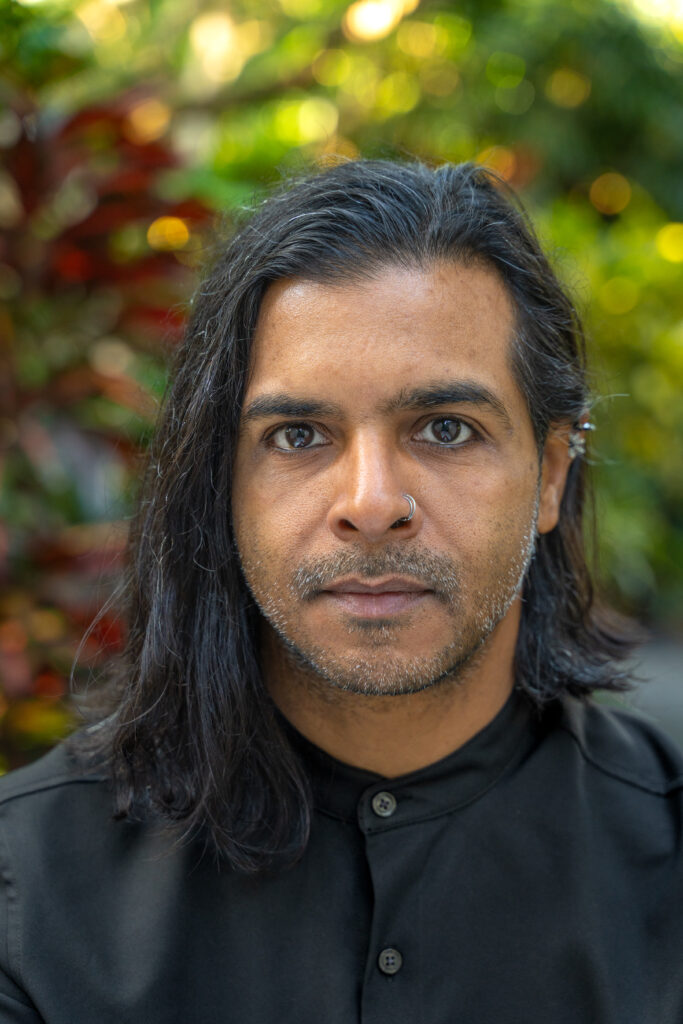
Above: Pseudomero; photo by John Eder
Mero, as everyone calls him, and his family departed from their native Puerto Rico in 2021 seeking new opportunities in Florida. Their beloved archipelago had been decimated by Hurricane María in 2017, wounded by earthquakes in late 2019, and economically devastated again during the COVID-19 pandemic. Mero, an artist and university professor, watched his clients and students disappear in the storm’s wake. His spouse, Dr. Dianne Brás-Feliciano, is a museum curator; the couple worried about their long-term prospects on an island still deep in recovery when COVID hit.
The family settled, at first, in Broward County.
“It was very complicated. My mind was everywhere,” says Mero. On long walks each morning, he noticed palm trees, a species he’d been similarly drawn to in Puerto Rico. The familiarity was comforting—a bridge between the home he loved and the place he resided but did not yet consider “home.”
Where is home? What is home? he wondered as he walked.
Using photographs of palms that he took in both places, Mero began to reinterpret them through an artistic lens. This series, Trópico-Sub-Trópico: ¡Que viva la palma! (Tropical-Subtropical: Long Live the Palm trees!), combines graffiti with expressionism. The brush strokes and color choices are vibrant, bold, playful. (Mero got his start in graffiti, an art form that incorporates the artist’s name or “tag.” Pseudo is short for pseudonym; Mero is abbreviated from his last name, Romero. He doesn’t use his given name publicly.).

The family moved to Naples in May 2023, and Mero turned his attention to bromeliads, which, like palms, span both Florida and Puerto Rico. The family hikes weekly, immersing themselves in Southwest Florida’s vast conservation lands. Mero photographs plants “obsessively” along the way.
Bromeliads spoke to “home,” too, Mero thought. With their stiff, overlapping leaves, bromeliads capture rainwater and plant debris that feed and nourish wildlife ranging from insects to frogs.
Mero likes to experiment with form and style. This series, Bromelias en serio (Seriously Bromeliads), borrows from impressionism, rendering a more classical outcome than the playful palms. Mero depicts bromeliads in multiple settings, from many angles, and at varying points in their life cycles. In Transfiguración, 2025, he depicts a cluster of dying plants. Mero wanted the artistic challenge of working with muted colors following the more vibrant palms and to convey a message about decline and renewal. “They are not really dead,” he says. “They are transforming. They are giving nutrients to different species, so their lives don’t end there.”


Audiences might take away many ideas from the exhibition. Mero hopes it leaves them with a new appreciation of the tropics’ beauty and an understanding of what’s at stake when we threaten the natural world. But, like layers of paint, the artist embedded other ideas. The subtitle ¡Que viva la palma! is the artist’s invitation for Puerto Ricans to discuss and debate their homeland’s future. That phrase is used by one political group, the pro-statehood New Progressive Party, which currently rules Puerto Rico but does not represent those who are pushing for independence or to remain a U.S. territory.
In the United States, audiences aren’t likely to pick up on that message, but instead, they might recognize a core value very much celebrated here: ingenuity.
Mero came to Florida with neither supplies nor the artistic reputation he had honed in his 20-plus years on Puerto Rico’s vibrant art scene. His first formal job here was with an arts organization in Broward. There, staff built movable partitions from wood frames and fabric drop cloths to cordon off space for summer camp activities. With his manager’s permission, Mero gathered the fabric scraps, borrowed a sewing machine, and spent two weeks stitching the uneven bits into a usable bolt of fabric. Later, when he was employed by a museum, he was invited to take home remnant paint. These leftovers gave him all he needed for the palm series.


For the bromeliads, as well as a mural in Fogg Café, Mero was sparing in a different way. He used only primary colors—red, blue, yellow, white—to replicate an entire spectrum of nature’s hues. He used repurposed canvases for the bromeliad paintings, too.
“You can do so much with so little,” he says. That’s a lesson he learned growing up in Puerto Rico with few resources. “I try to translate that life experience into creating something complex.”
Historias del aire y del suelo is his first solo exhibition outside of Puerto Rico. When Curator of Arts and Culture Sten Kerwin met Mero, his work and the messages embedded within it resonated. “I try to go beyond what the eye sees. I look for artists who are deeply connected to and interested in the natural world,” she says. “With each brushstroke, Mero tells a story or shares a message with the viewer. It’s up to us to open our eyes and listen.”

The exposure is helping him grow a following in Naples. Some viewers have commented that the bromeliads look so real they mistook them for photographs. Others have expressed surprise that both series were done by the same person, a testament to his versatility.
Mero was raised in the city but spent about a decade in the country, immersed in nature. Around that time, he grew closer to his mother, an avid gardener eager to share her passion. She likewise passed on her love of the arts, as did Mero’s father. His entire family, including two brothers, are writers, musicians, designers, and artists.
In 2016, Mero was selected as Artist in Residence for the City of Bayamón, Puerto Rico. During his four-year tenure, he experimented with non-objective art, a style focused on design rather than the portrayal of real-life objects. The creation of these tends to be spontaneous; when Mero stepped away from a completed canvas, he realized that his images nearly always looked like landscapes.

In Fogg Café, Mero returns to an impressionistic style as he puts a big spotlight on three tiny native plants: a twisted airplant (Tillandsia flexuosa), clamshell orchid (Prosthechea cochleate), and cardinal bromeliad (Tillandsia fasciculata). All three species are found in the Garden’s Preserve. The twisted airplant is listed as “threatened” in Florida; the two others are considered “endangered” in the state.
Mero says he wanted to focus on at-risk species. “The reason I’m doing what I do is to create a consciousness,” he says. “We can lose it in a second if we don’t work together.”
The mural, Ánima Botánica (Botanical Anima), is part of Hidden Wonders, the Garden’s artistic and programmatic theme for 2026 – 2028. The title translates roughly as the “soul” or “inner power” of plants, Mero explains.
He adds, “I think of nature as a being, not a thing.”
Historias del aire y del suelo | Stories of Air and Soil is included with Garden admission, free for Members. The Fogg Café mural, Ánima Botánica (Botanical Anima) is part of Hidden Wonders, the Garden’s artistic and programmatic theme for 2026 – 2028, supported by the Schoonmaker Foundation.
Garden Exhibitions are Supported By