Practitioners reveal the science–and art–of redirecting nature’s sometimes deadly force for good
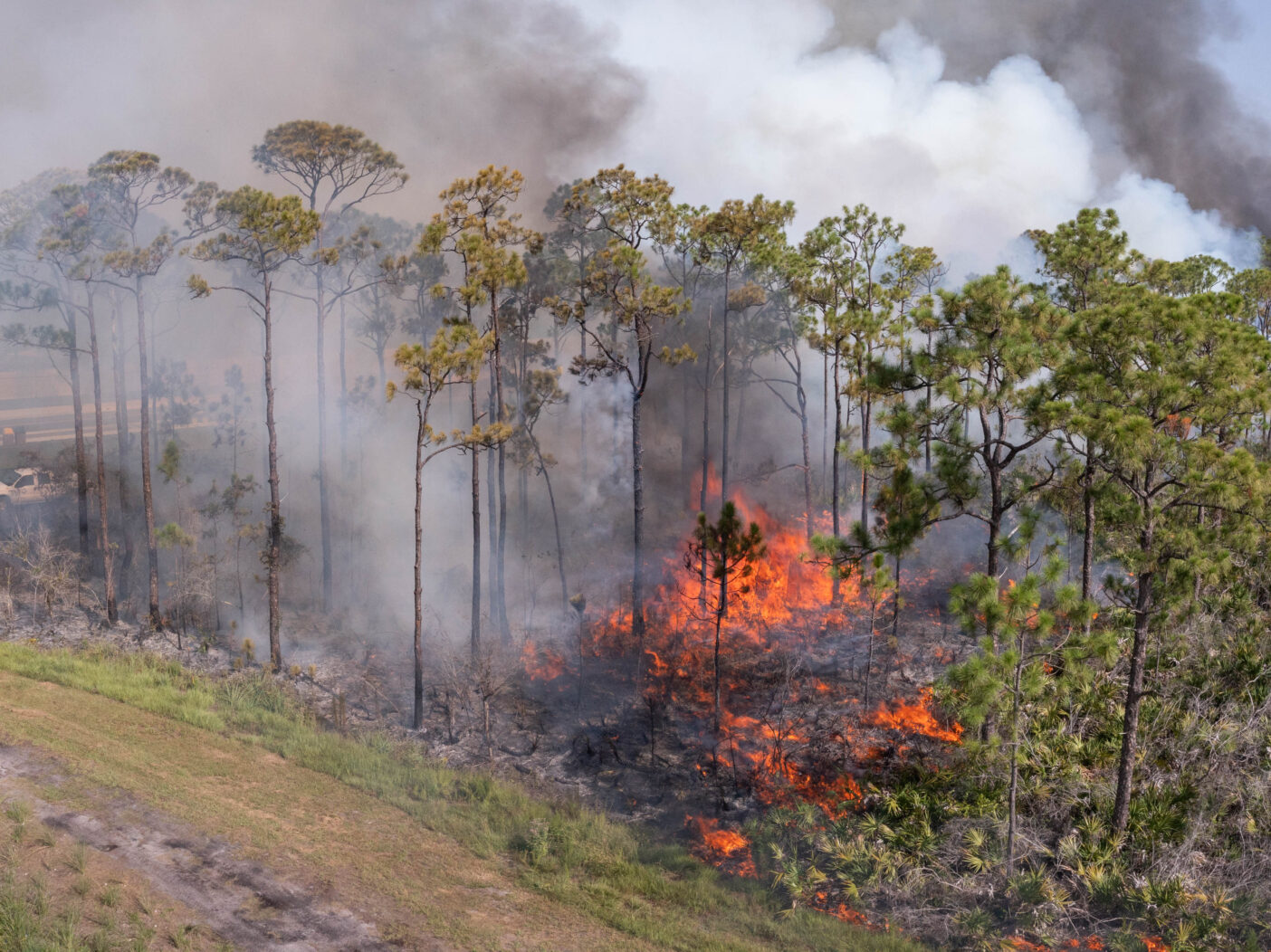
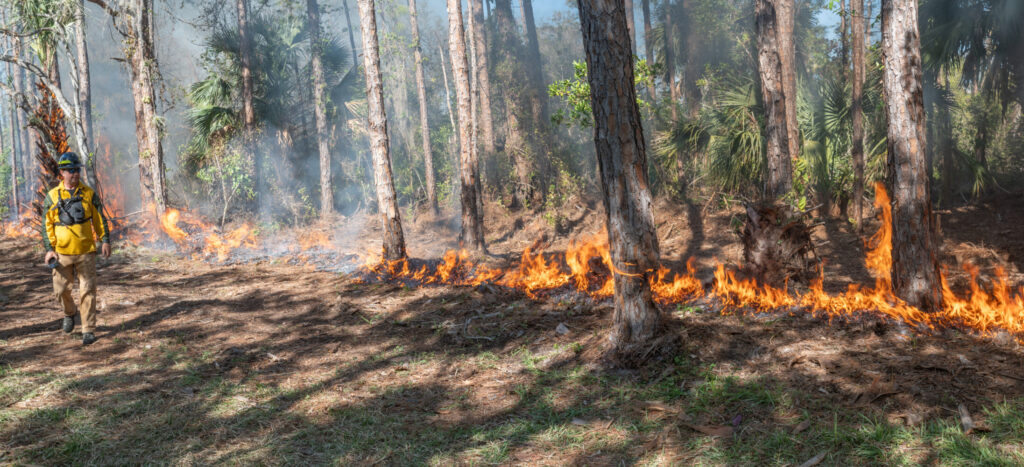
A flamethrower inches along the Garden’s southern border, spewing an orange flame into a stand of pine trees. Fallen needles and leaves ignite instantly. Within seconds, flames climb the trunks … 1 foot, 5 feet, 10 …. until a fiery wall marches into the forest.
Thaddeus Penfield, the burn boss and owner of Willowcreek Fire Company, grins. “This is a full-on wildfire right here,” he exclaims, defining the blaze’s look and feel. It is not, of course. Penfield instructs the 17-member crew to temper flames that grow too intense and intensify those that struggle to gain traction—a little like an orchestral conductor hushing brazen trumpets and urging more oomph from delicate violins.
On that same January day in California, an actual wildfire forced tens of thousands of people from their homes. Hurricane-force winds pushed a blaze out of the Santa Monica Mountains and into Los Angeles County, where it—and several concurrent fires—would burn for weeks, causing an estimated $250 billion in damage. The three biggest blazes would scorch some 48,000 acres, consume more than 16,000 structures, and kill 30 people. Images were horrific: homes engulfed in flames, exploding cars, residents standing dazed amid the ruins.
Amid those two oppositional fires, I wanted to understand how a force so brutal could be tamed and tapped for good.
I turn to Penfield: “How do you control fire?”
He looks away from the blaze. “We don’t,” he answers. “We persuade it.” Over the next few hours, he’ll show exactly how.
Fire is synonymous with Florida. From the grasslands to the pinewoods, ecosystems have evolved to depend on periodic purges. People learned to harness fire, too. Indigenous cultures burned to clear land for crops, facilitate hunting, and promote the rejuvenation of native plants. European settlers followed suit.
Attitudes toward fire, however, changed around the start of the 20th century. Devastating blazes such as the Great Fire of 1910, which consumed 3 million acres in the Rocky Mountains, led to a nationwide policy of fire suppression.
In fire’s absence, plant debris, such as fallen leaves, pine needles, and branches, accumulated on the forest floors. Sparse understories grew thick. This buildup is what fuels wildfire.
Meanwhile, ecosystems—even those that looked verdant—deteriorated. Plants were snuffed out by their own debris. Sun-loving species faltered because canopies thickened and blocked light. In Florida, plants that depend on fire to reproduce, such as Florida rosemary (Ceratiola ericoides) and longleaf pine (Pinus palustris), couldn’t do so. Once-prevalent species, like wiregrass (Aristida stricta) and cutthroat grass (Coleataenia abscissa), mostly disappeared. Insects and wildlife that utilized those species suffered.
In recent years, though, land managers have reintroduced fire for human safety and ecological health. Wildfires burn an average of 1 million acres per year in the United States. They’re becoming more prevalent. By May, the nation had already hit that mark, according to the National Interagency Fire Center. Increasingly, public officials are trying to figure out how to burn plots of forested land near residential areas so that an unintended blaze doesn’t consume a neighborhood.
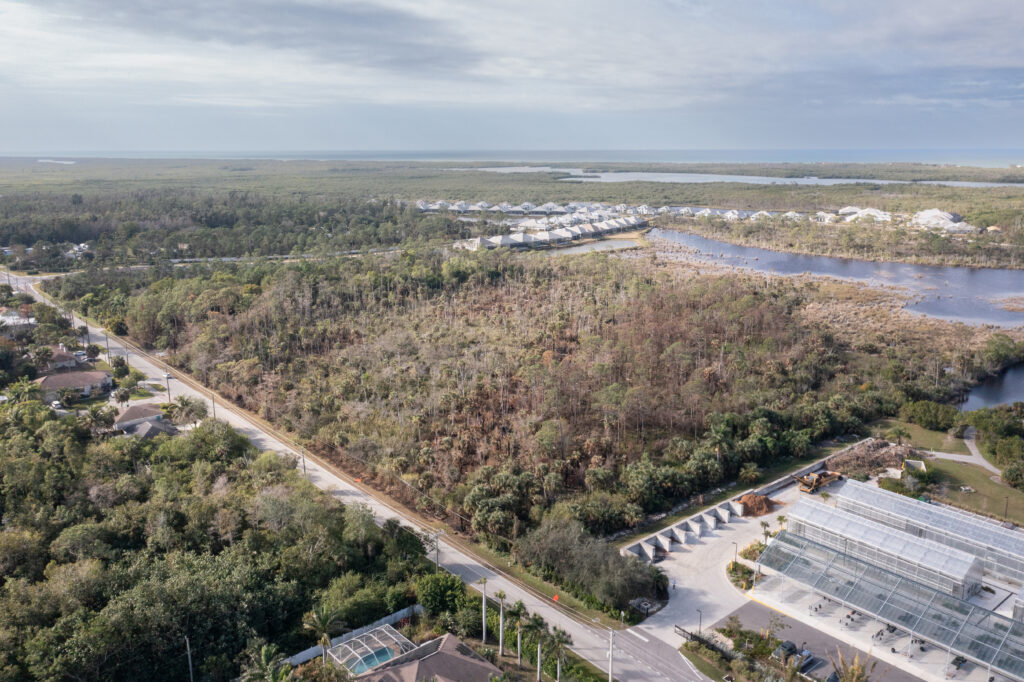
The Garden’s Natural Resources Director, Eric Foht, started campaigning for a prescribed fire regimen about a decade ago and, with his team, spent several years preparing themselves and our property. This January blaze is our eighth burn since 2022, making the Garden one of the few private entities in Florida to conduct “urban interface burns.” Today’s fire illustrates the practice’s complexity—a private home is adjacent to the 8-acre designated burn unit. The entire operation has been planned to ensure its safety.
Seventeen people, including fire-certified staff from the Garden, partnering conservation groups, and personnel from the East Naples Fire Department, are here to manage the fire. Early this morning, they laid hoses the length of the fire break and parked a fire engine, reassuringly, along Bayshore Drive.
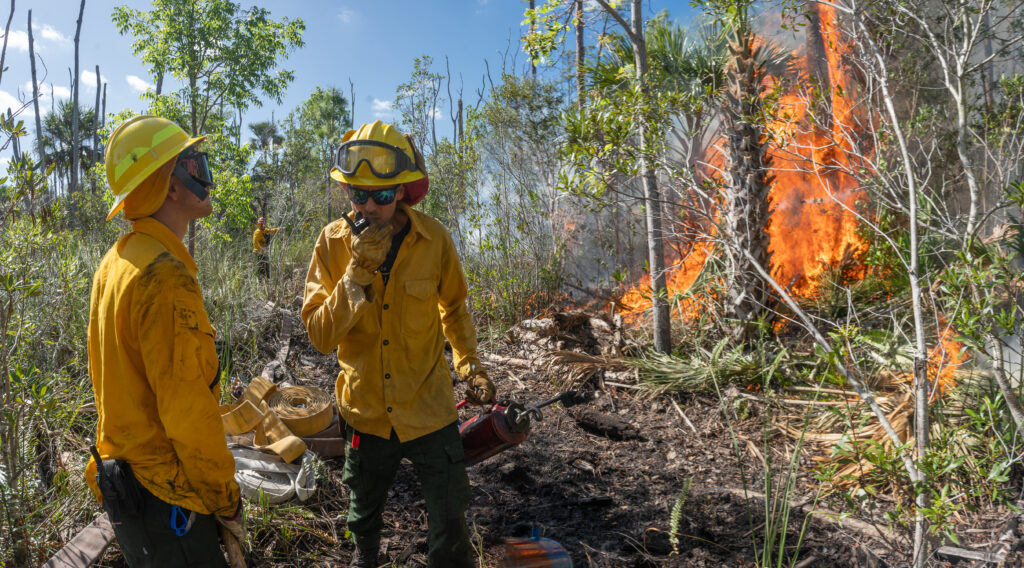
Penfield outlines what to expect: The pine flatwoods section will ignite easily and spectacularly. The soggy marsh will not, so the crew will approach it from two fronts. Patches of fire are like magnets, drawn to each other.
“We’ll have this big show at the corner, and then everything will be tranquil again, and then we’ll spend the rest of the day pushing her to eat, pushing her to move,” he says.
To Penfield, each fire is a “living, breathing personality” with its own characteristics, mood swings, movement patterns, and behaviors. Its handlers coax it toward its intended target, hoping it’ll cooperate, ready to take action if it doesn’t.
“We have to plan for the worst-case scenario,” Penfield says. “Every fire you go into, you need to be anticipating you’re gonna fight it.”
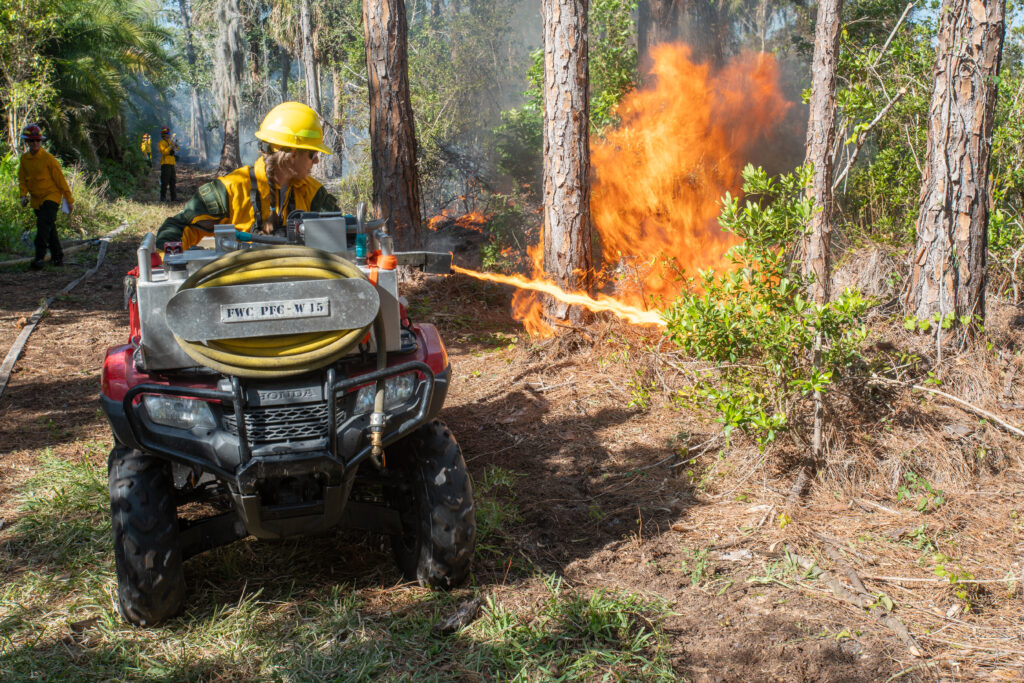
The science of fire is really the science of weather. To encourage a blaze into submission requires complex calculations involving temperature, humidity, wind speed and direction, dew point, time of day, cloud cover, and a host of other atmospheric conditions.
Today’s forecast predicts a low of 48 and a high of 72. The cool temperatures will calm the blaze. Clear skies, however, will encourage it to climb, as if trying to reunite with the sun, Penfield explains. Knowing this behavior helps the crew keep the flames in check. Several members, overseen by Natural Resources Manager Mike Cox, position themselves along the line of hoses and stand at the ready. Among other things, Penfield instructs them to watch for embers that could float into the underbrush and flare up.
One of the biggest considerations in planning a burn is the “mixing height,” the atmospheric level at which smoke rises and disperses. Today’s, 3,400 feet, is well above the minimum threshold but low enough that smoke potentially could linger and impact Garden guests, pedestrians, and motorists. Penfield directs everyone to watch the billows of gray and white and ensure they don’t create a problem.
The wind blows from the southeast, a direction more typical in summer than winter, and it carries welcome moisture. If humidity levels are too low, a fire will rage out of control, if too high, plant matter simply won’t ignite. Today’s is a mid-range sweet spot.
Wind direction is predicted to shift sometime around midday, and the crew will have to adjust their strategies accordingly. In truth, winds can change at any time. Foht grew up along the Gulf, fascinated with sailing and weather, and is so attuned to the region’s meteorological nuances that he can sense shifts in wind patterns.
“If you know a place well enough and have spent enough time reading the forecasts and then comparing those to what actually happens, you can get a sense of what to be prepared for,” he says. That kind of intuition makes prescribed burning as much an art as it is a science.
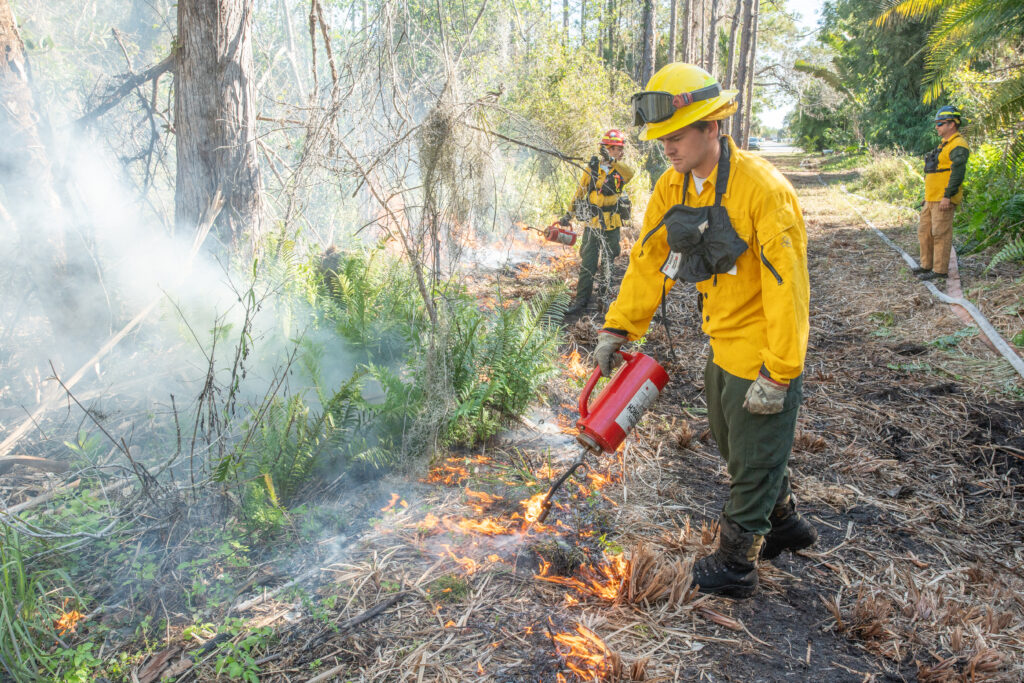
There are three types of fires that practitioners can set, and they weigh factors such as topography, moisture levels, plant types, and objectives in deciding which to ignite. A head fire moves with the wind and marches quickly and intensely across the landscape; a slower-paced backing fire pushes against the wind; and a flanking fire starts out along the designated area’s side and then splits into a head fire and a backing fire.
Today calls for head fire. The sawgrass marsh, with standing water, will need the wind’s force to urge the flames along. The highly flammable pine flatwoods section needs wind energy for a different reason. Over the years, some 15 inches of fallen leaves, pine needles, sticks and branches, known as “duff,” have accumulated. Reducing it requires a fast-moving blaze to skim the ground’s surface. When duff is that thick, trees mistake it for soil and send roots into it. Penfield and Foht intend to shave the layer a few inches at a time, giving the pines a chance to adjust and pull their roots underground.
“Over time, we’ll get this ecosystem back into some semblance of health,” Penfield says.
The marsh, as predicted, is tricky. The crew first sets it ablaze from the south and later, as the wind shifts and the temperature rises, attacks it from the north.
Penfield turns to Foht. “You can be as reckless as you like!” He’s teasing, though Foht knew he could be somewhat aggressive. Two months earlier, the Garden had burned an adjacent parcel, depleting dead plant matter to limit the chance of this fire spreading beyond its designated boundaries.
The blaze eats through dry patches of sawgrass and fizzles in wet ones. Foht and Penfield had contemplated waiting for more favorable conditions, but their primary concern is the neighbor’s house, and today’s wind direction is ideal for its safety.
“You only get one shot,” Penfield says. “If we have a bad fire, that’s all anybody is ever going to talk about. They’re not going to remember the seven fires we conducted flawlessly.”
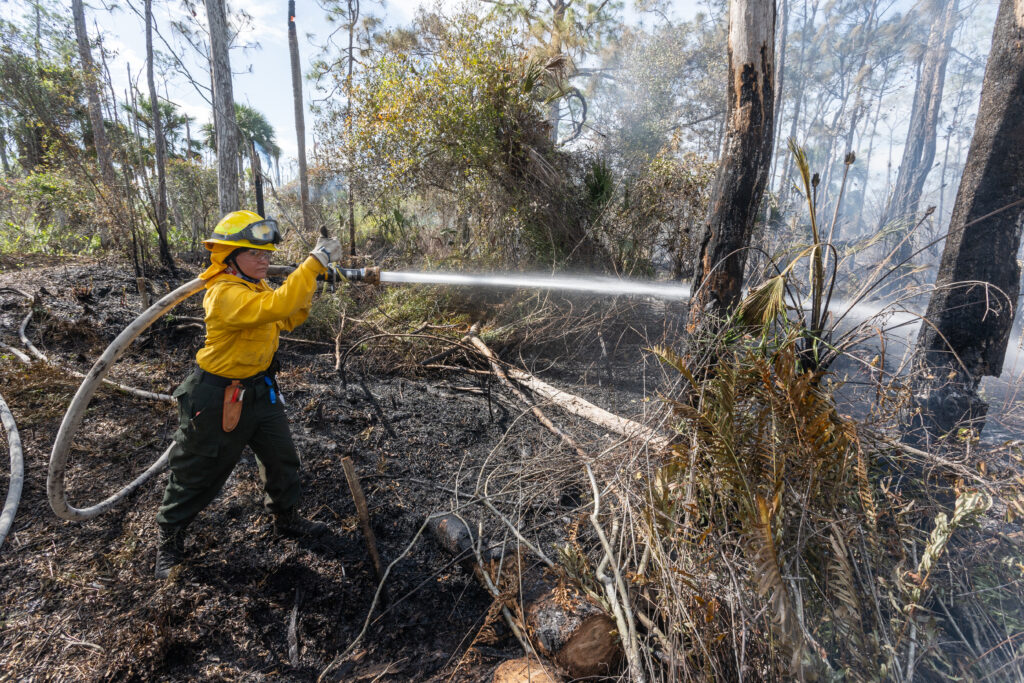
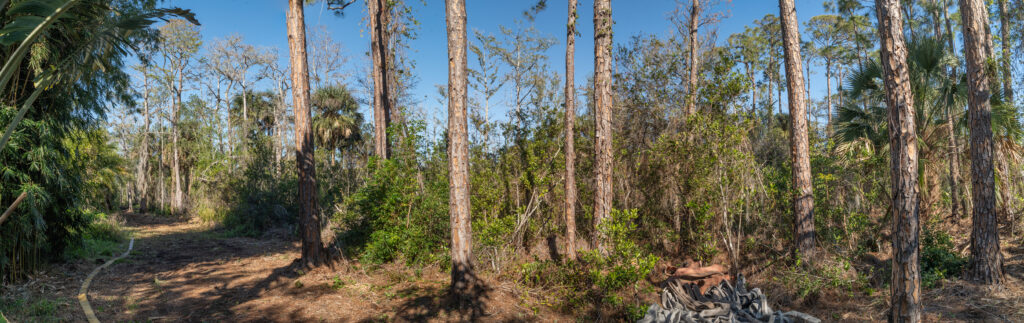
Six months later, fresh green ferns carpet the ground. If not for the charred bark, you might not know a fire had ever happened. The speed at which tropical plants grow is why periodic fires are important to keep them in check. Wildlife appreciates the new growth and the rebalanced ecosystem, and we’ve documented numerous instances of rare native plants flourishing after blazes like this one.
The wetland hadn’t burned as much as Foht would have liked, but it cleared enough to make an upcoming planned fire, a 2-acre parcel near the James and Linda White Birding Tower, possible. That marsh is one of the Garden’s biggest accomplishments; years ago, founding staff members rid it of invasive melaleuca trees, reintroduced native grasses, and restored the land to health. A prescribed burn will help ensure the ecosystem continues to function as nature intended.
But that’s not the only reason for planning this blaze. A neighborhood overlooks the grassland, a reminder of the Garden’s responsibility to maintain our land for the well-being of people, too.
Gazing at this intersection of natural land and residential development, Foht says, “We want to show, quite literally, that it is possible to live alongside fire with careful planning, expert practitioners, and a community that is educated about the benefits of prescribed fire and willing to support this process.”
This article first appeared in the 2025 issue of Conserve, the Garden’s conservation magazine.