
The Garden hosts a group of voracious predators that you may unknowingly pass. Fear not! I’m talking about plants and their appetites for insects. Carnivorous plants live in some of the world’s toughest environments and to do so, they’ve evolved into the flesh-eaters of the plant world.
When one thinks of carnivorous plants, the Venus flytrap is likely the species that comes to mind, as it is often found within the plant industry. But it is far from the only one of its kind. There are between 600 to 800 known species of carnivorous plants found around the world, with Antarctica being the only continent that does not have any. Florida has around 42 species, which is more than any other state in the United States! Here in Naples Botanical Garden, we have six, and they are primarily found in areas where the sun can reach the forest floor, such as in our prescribed fire sites. Two are especially prominent: sundews and bladderworts.
Carnivorous plants grow in ecosystems that consist of bogs, swamps, forests, rocky/sandy soils, or other habitat types that tend to have limited nutrients. To compensate, over the course of millions of years, they developed vegetative structures to catch insects, allowing them to absorb the nutrients they otherwise lack. There are a variety of leaf modifications that help attract prey, such as the vivid red coloration of the traps or the sweet-smelling scent they emit.
Sundews offer a perfect example of how carnivorous plants thrive in the harshest environments. We have two species, the dwarf sundew (Drosera brevifolia) and the pink sundew (Drosera capillaris). Both can be found growing in the Garden’s scrub habitats, which have low-nutrient sandy soils.
Carnivorous Plants at the Garden
Sundew
Sundews are characterized by their spoon-shaped leaves, which are red and green in color and contain small hairs called trichomes. These hairs secrete a sweet and sticky substance that may be mistaken for drops of dew or nectar by unsuspecting prey.
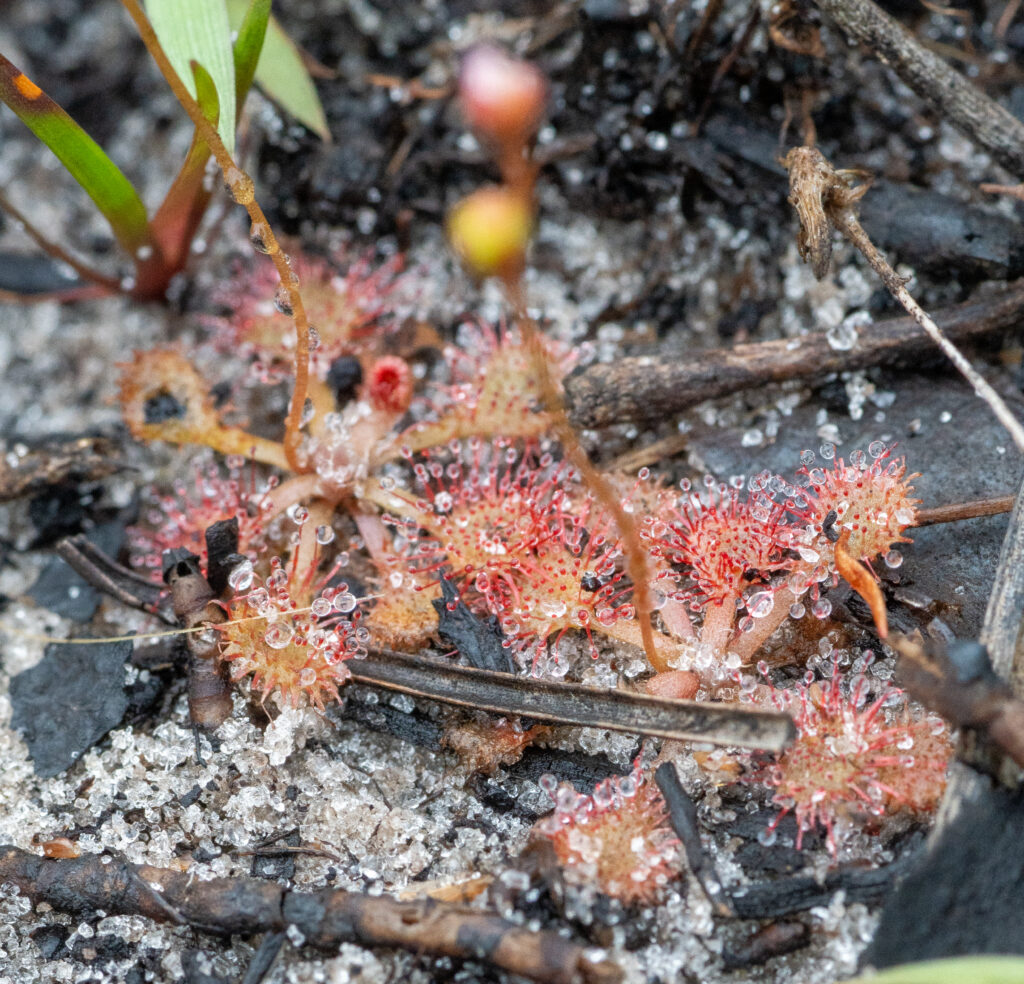
Photo by Isabella Danaher
Once an insect lands on the leaf, it becomes stuck, and the leaf slowly folds inward to digest the insect by producing digestive enzymes. The more the insect struggles, the more ensnared it becomes. Once the digestion is complete, the leaf unfurls, resets, and is ready to catch more insects.

Photo by Isabella Danaher
Bladderwort
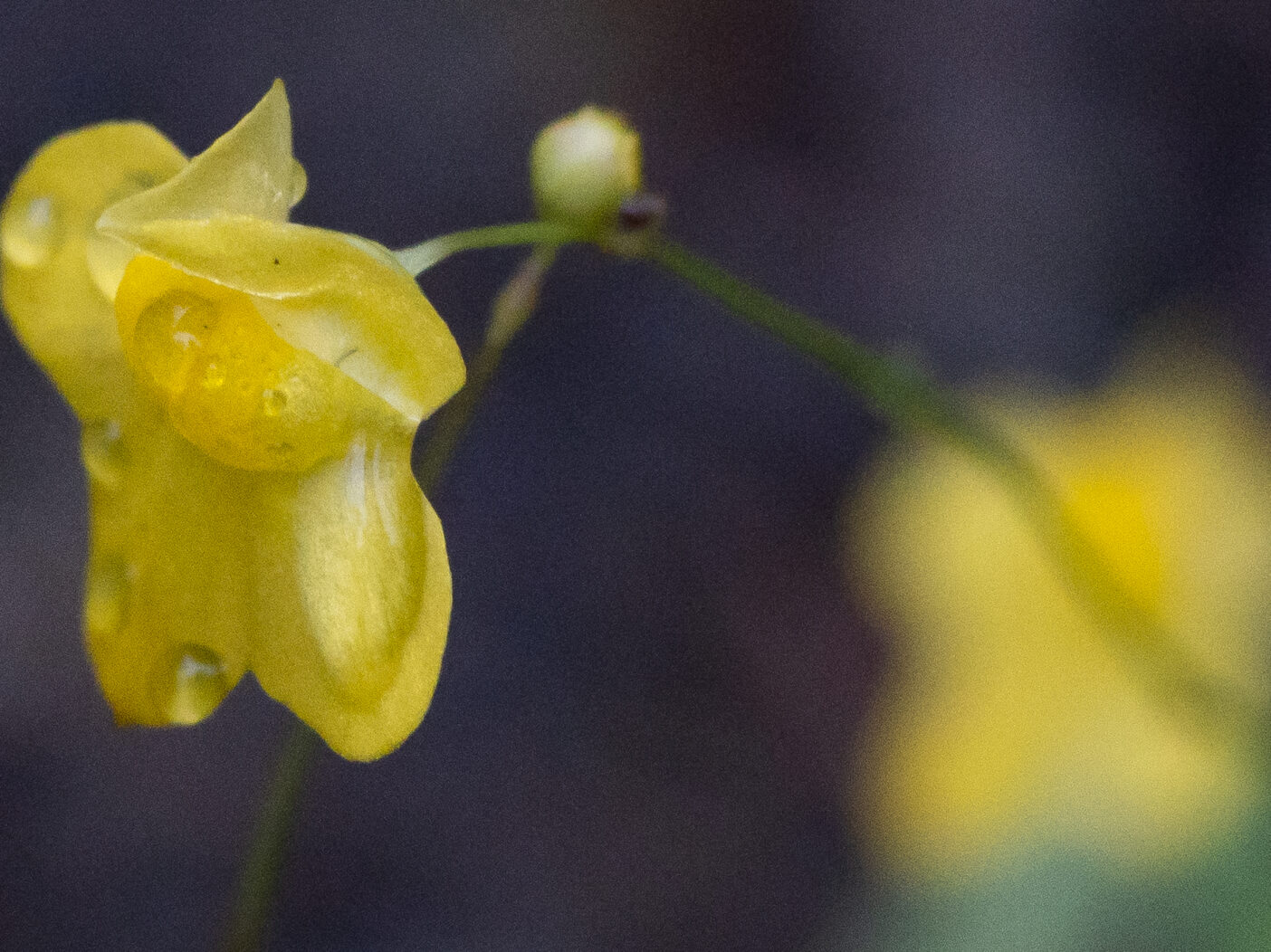
You can find four fascinating species of bladderwort at the Garden. There are two terrestrial species, the zigzag bladderwort (Utricularia subulata) and fringed bladderwort (Utricularia simulans), and two aquatic species, the Eastern purple bladderwort (Utricularia purpurea) and the leafy bladderwort (Utricularia foliosa).

Photo by John Eder
Bladderworts are often easily overlooked due to their unassuming nature. If you are lucky enough to spot them, you will see that they have small pea-sized flowers. Depending on the species, the flower will either be a rich bright yellow or a beautiful light purple with a yellow center. Although they lack true roots, they possess a similar structure, which is made up of a cluster of stems with modified leaves. These modified leaves are small, spherical bladders known as utricles that grow abundantly along the stems. The utricles are used to obtain nutrients. Each bladder has a trap door with tiny hairs; when triggered, the door opens inward, creating a vacuum that pulls the organism inside, where it is then digested.
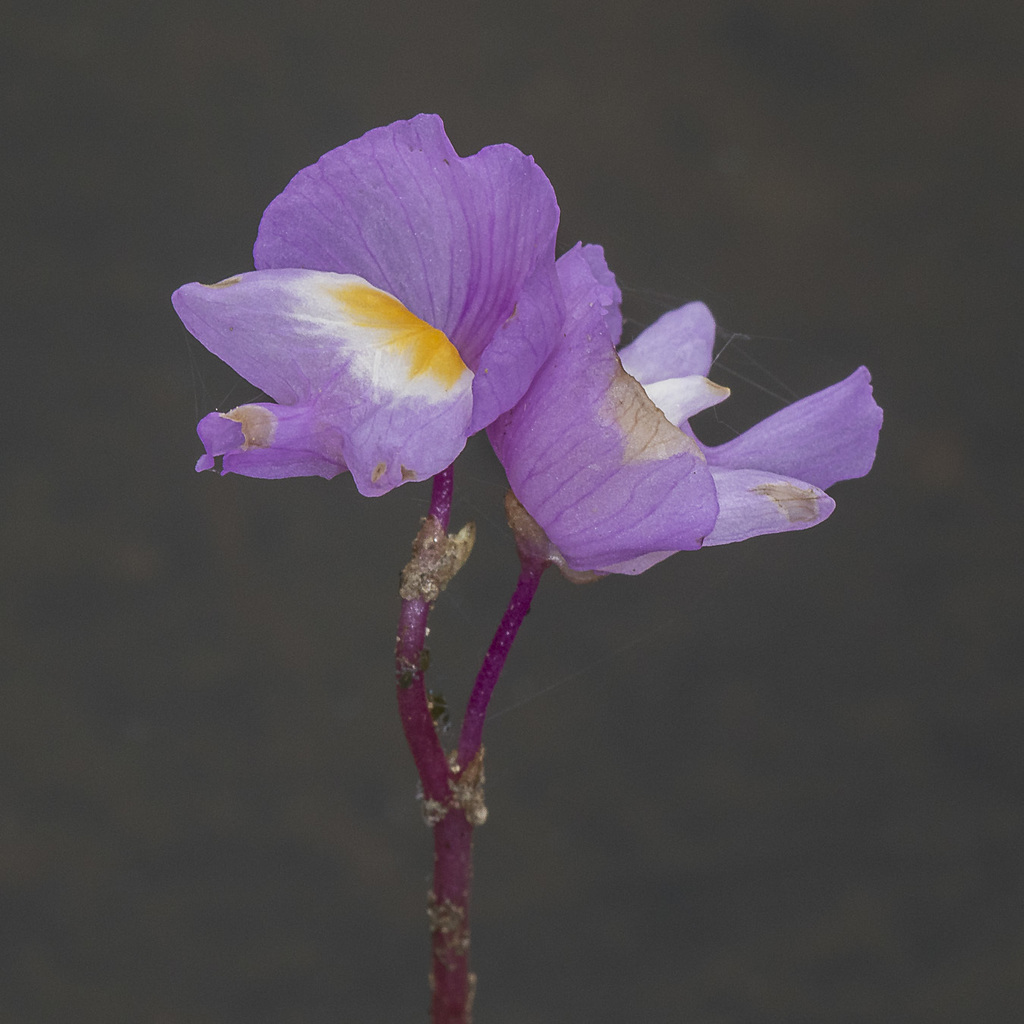
Photo by Allen Wells via iNaturalist
You may be wondering what kind of insects these plants consume. Since they are found in various regions, it is difficult to pinpoint their exact diets. However, by examining the size of the traps, we can estimate what their prey may be. Bladderworts have utricles about the size of a pinhead, so they are limited to small organisms like mosquito larvae and other small aquatic insects. Sundews, on the other hand, may attract small insects, such as flies or ants, which are drawn to the smell or color of the leaves.
I can tell you more definitively the kinds of insects my homegrown carnivorous plants eat. I have a collection that I keep outdoors. I have observed my Venus flytraps and my sundew catching mosquitos when they are plentiful and active, while my pitcher plant has nabbed ants and roaches in its traps. These observations have led me to believe that growing carnivorous plants is a great way to reduce some insect populations that we’d rather not have in and around our homes. Talk about all-natural pest control!
As a final note: If you find a carnivorous plant—or any other plant you covet—in the wild, let it be! It is important to not disrupt the natural workings of ecosystems. In addition, a species may be listed as threatened or endangered (such as wild Venus flytraps), and by removing individuals, you are taking valuable genetics from the population that could leave it crippled.