Historias del aire y del suelo / Stories of Air and Soil, the exhibition by artist Pseudomero on display in Kapnick Hall until October 25, is an ode to two of Florida’s core plant groups—palms, possibly the most recognizable of tropical trees, and bromeliads, equally ubiquitous but far less understood.
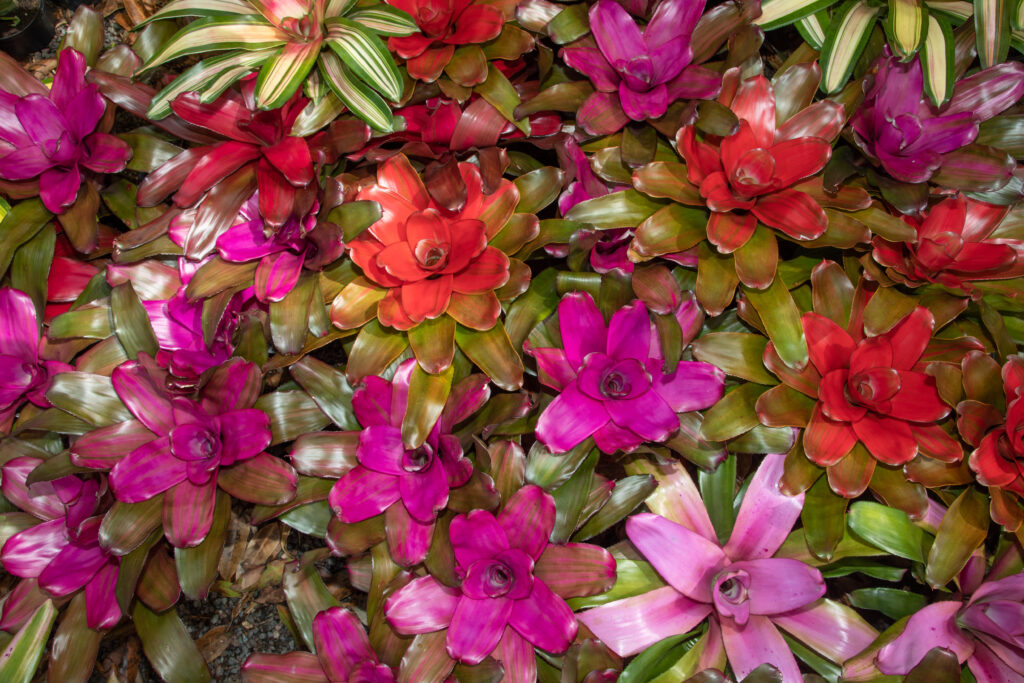
Perhaps one of the plant world’s hidden gems, bromeliads may be more familiar than expected. Pineapples belong to the Bromeliaceae family, as well as many common, low-maintenance houseplants. This diverse family contains over 3,500 described species distributed throughout the tropical Americas, with only a single species occurring outside of the Western Hemisphere.
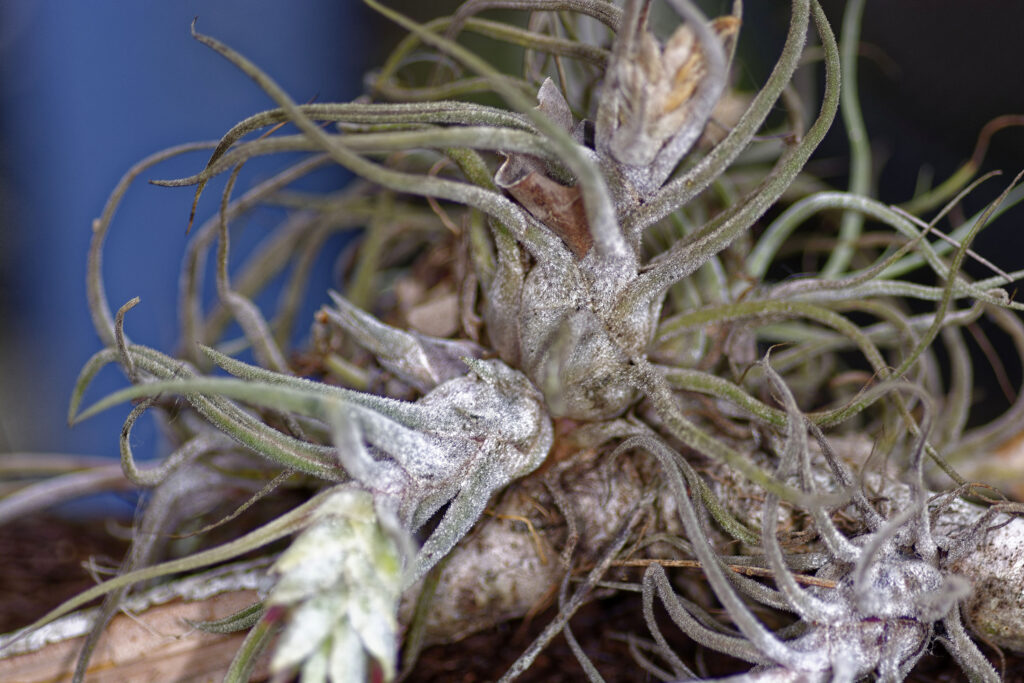
Many of the subjects of Pseudomero’s Bromelias en serio (Seriously Bromeliads) series belong to the largest genus of the bromeliad family, Tillandsia. Plants in this genus are often referred to as “air plants” for their rather mystifying ability to grow without access to soil. The profoundly misnamed Spanish moss (Tillandsia usneoides) is an example of this type of bromeliad. Botanically speaking, tillandsia and other tree-dwelling bromeliads are known as “epiphytes,” plants that grow on the surface of other plants. While this may sound like quite the intrusion of personal space, epiphytes are not parasitic and cause no harm to their “host.” In fact, tillandsia roots are not responsible for nutrient and water uptake; they simply help secure the plant to a trunk or branch. Instead, tillandsias have trichomes, a fine, hair-like feature that allows them to sequester water and nutrients from the air. Trichomes are responsible for the grey-green color and slightly fuzzy appearance of many tillandsia species. With keen eyes, sparkling silver tillandsia tendrils can be found not only in Pseudomero’s Fuera de foco and El lado oscuro de la floración, but also on the branches of trees across the southeastern United States, Caribbean, South and Central America.
The artist painted this series after a transitional period in his life, having just relocated from his native Puerto Rico to Southwest Florida. Bromelias en serio is his first series done entirely in Florida, based on his immersion into the region’s incredibly diverse landscapes.
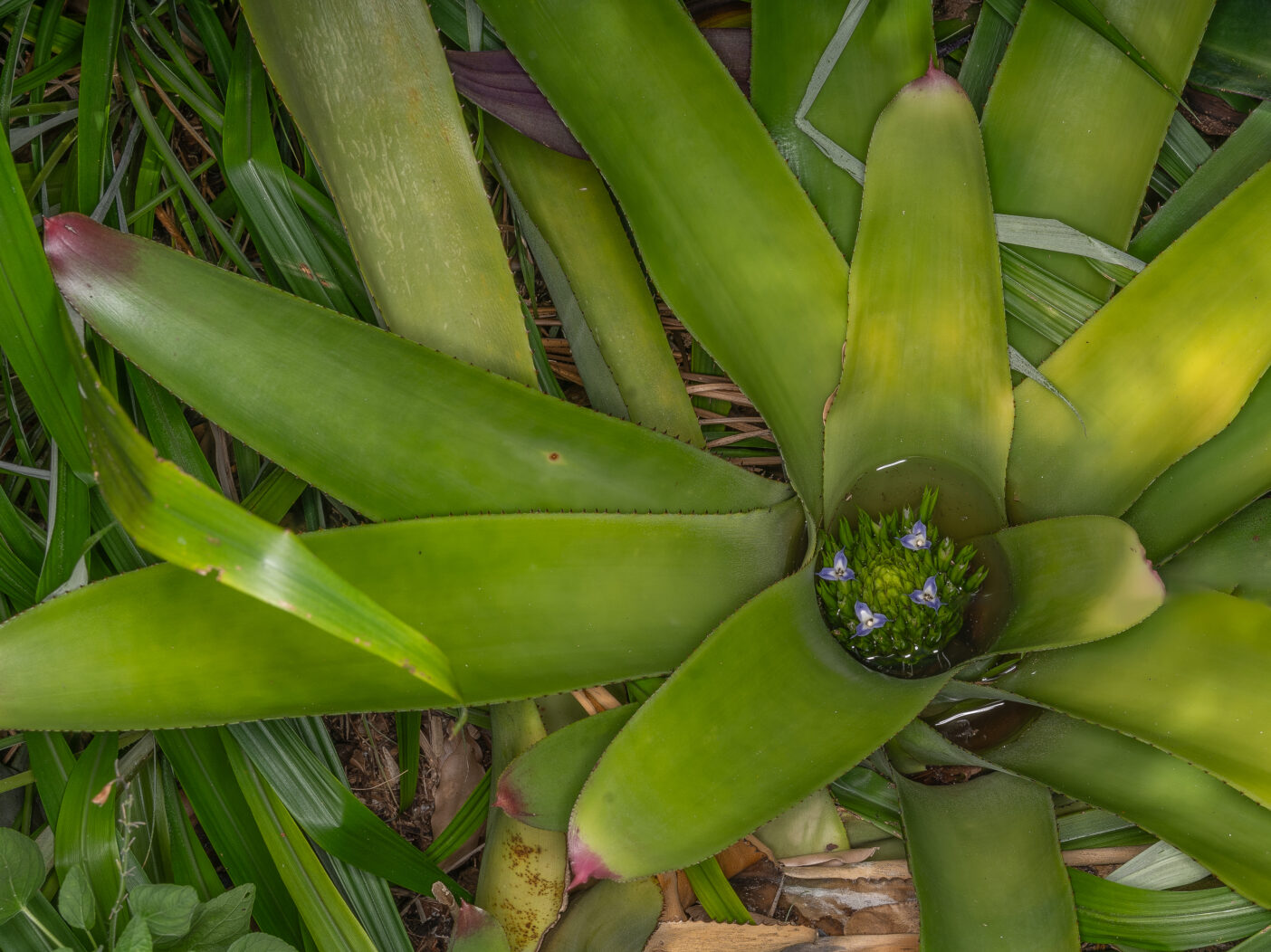
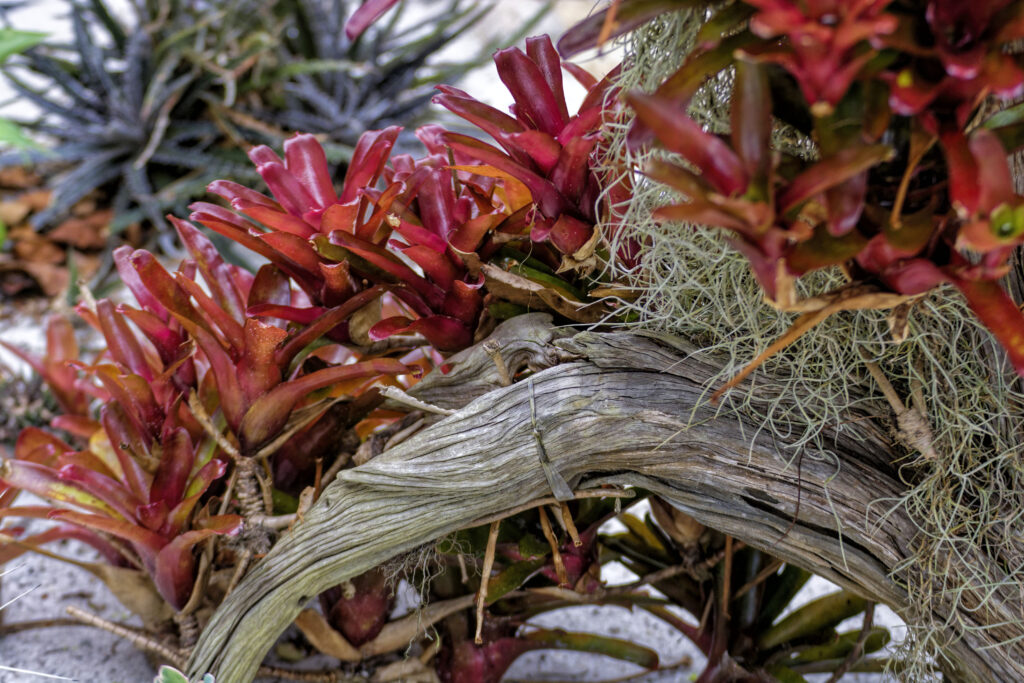
Bromeliads, he noted, serve as homes unto themselves. The terrestrial ones—like the many you see lining the pathways of the Kapnick Brazilian Garden—feature spiraling leaves that form a central cup or tank. A study of 200 bromeliad species published in the journal Flora found that the largest of the tanks can hold as much as a gallon of water, effectively forming a tropical micro-aquarium. The reservoirs created by bromeliads provide vital water and critical habitat for hundreds of species, from microorganisms like bacteria and fungi, to many species of insects, and even larger animals like crabs and poison dart frogs. In fact, both the Jamaican bromeliad crab (Metapaulias depressus) and the strawberry poison frog (Oophaga pumilio) are essentially endemic to tank bromeliads, rearing their young only in the sheltered aquatic habitat the tanks provide. Though neither species can be found in Florida, our tank bromeliads still play an essential role in recycling nutrients throughout the food web and providing crucial habitat for insects that are fundamental to the ecosystem.
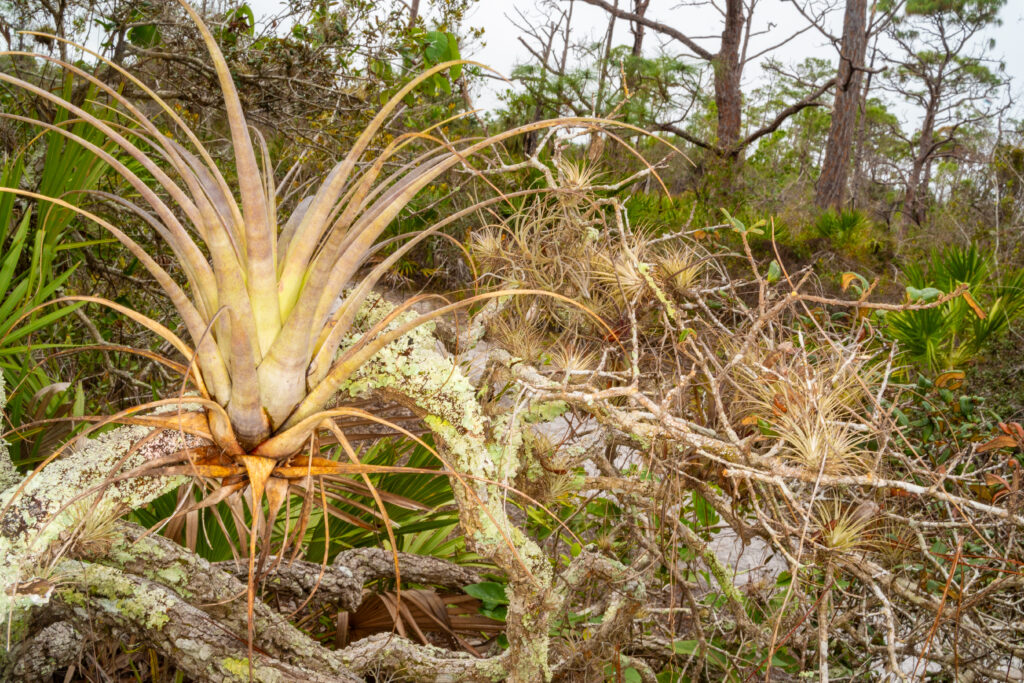
Due to a plethora of challenges in their tropical habitats, including land-use changes, introduction of invasive species, and overexploitation, many species of bromeliads are facing never-before-seen threats. Florida is home to 16 native tillandsia species, 10 of which are considered threatened or endangered. The introduction and rapid spread of the invasive Mexican bromeliad weevil (Metamasius callizona), whose diet consists exclusively of tillandsias, has introduced yet another challenge to this already imperiled group of plants. This voracious insect has caused enough damage to the air plants of the region to earn the villainous nickname “evil weevil” and has a particular affinity for the giant air plant (Tillandsia utriculata). The Garden’s tillandsia conservation efforts included a partnership with Marie Selby Botanical Gardens in Sarasota and Fakahatchee Strand Preserve State Park in eastern Collier County. Their project, which took place about a decade ago, involved raising giant air plants in the safety of greenhouses and relocating them to the wild before flowering, giving the next generation of bromeliads a chance to establish the wild, sans evil weevil.
Pseudomero’s work is not only an invitation to connect with this group of commonly overlooked plants, but it also encourages us to reckon with what we could lose if we’re not careful. Bromeliads are an essential piece of our tropical ecosystems, and protecting them has the powerful effect of conserving the greater ecosystem.
Historias del aire y del suelo / Stories of Air and Soil, on display through October 25, is included with Garden admission, free for Members.