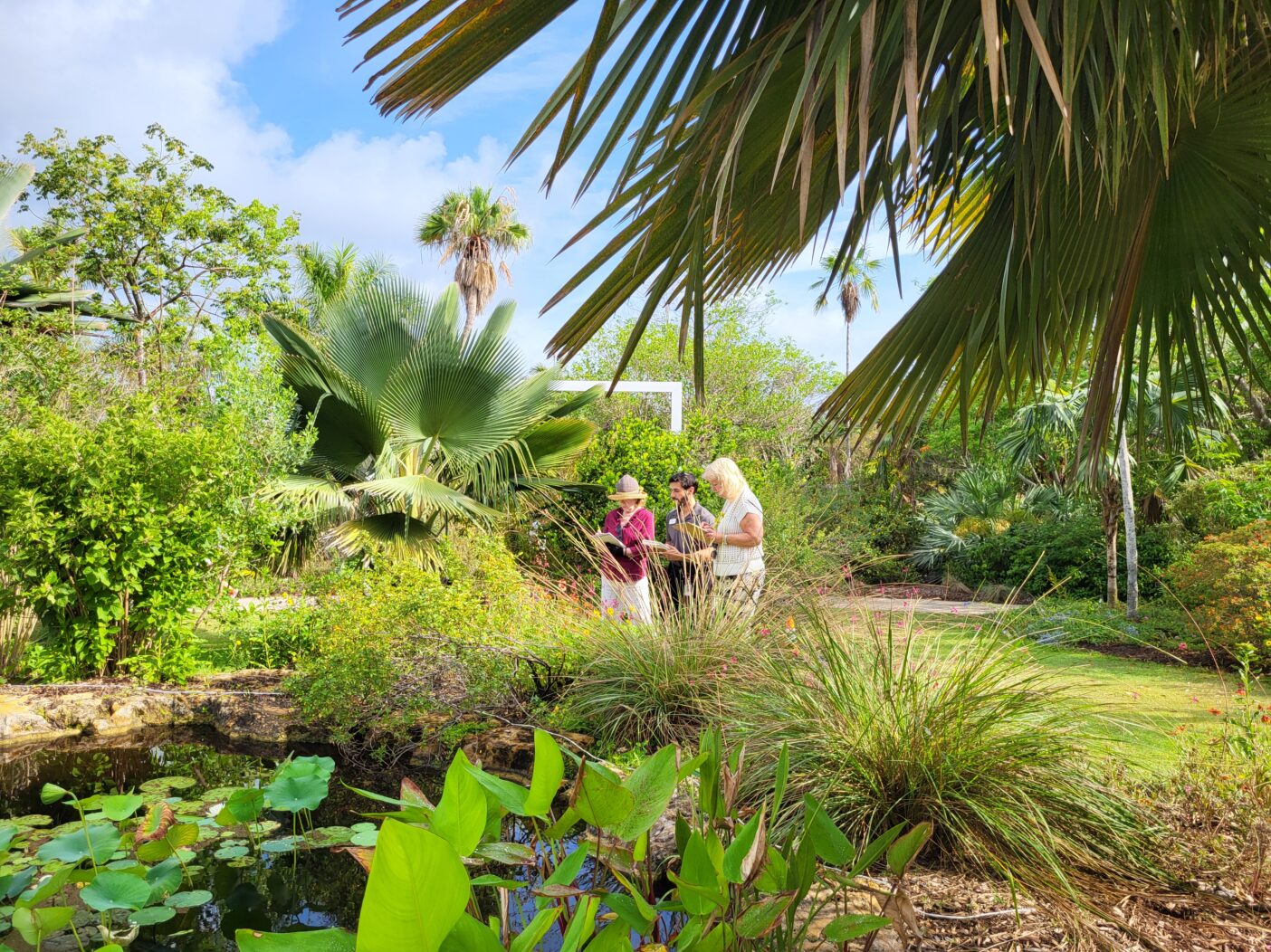
As the warm sun beams down and a cooling breeze drifts across the landscape, two women, sketchbooks in hand, intently observe a patch of Florida coreopsis. These are simple yellow flowers that resemble a common daisy. The women had most likely seen them before, since they are Florida’s state flower, though they study them as if they were the most exotic of blooms.
The women are students of the Garden’s long-running nature journaling program. Our course originated in the cultivated gardens, but, recently, I have been introducing Nature Journaling students and alumni to the wonders of wild Florida in our Preserve, using art to inspire new environmental advocates.
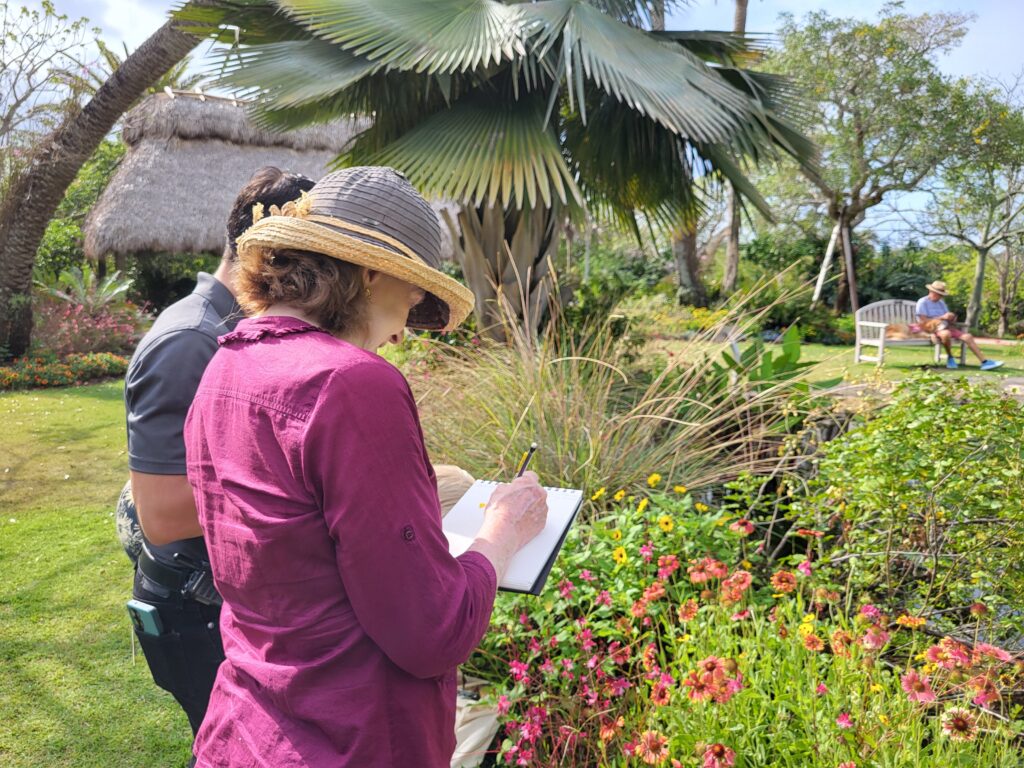
Above: Tobin gets close to her subject to capture details.
Photos by Kaitlyn Handley
Students tell me whether they’re in a manicured garden or an untamed preserve, a nature journal sparks a heightened awareness of their surroundings and turns a passive walk into an ecosystem study.
“When doing a simple walk, I feel that I am focused more on the pathway, direction, and distance,” says Nature Journaling student Kathy Tobin. She notices her surroundings when she’s bare-handed, of course, but not with the same scrutiny. “As I’m looking at the foliage, I’m noticing everything in more detail—distinctive shapes and forms, different color shades and details.”
Students report discovering previously unnoticed natural treasures as they attempt to capture scenes in sketchbooks.
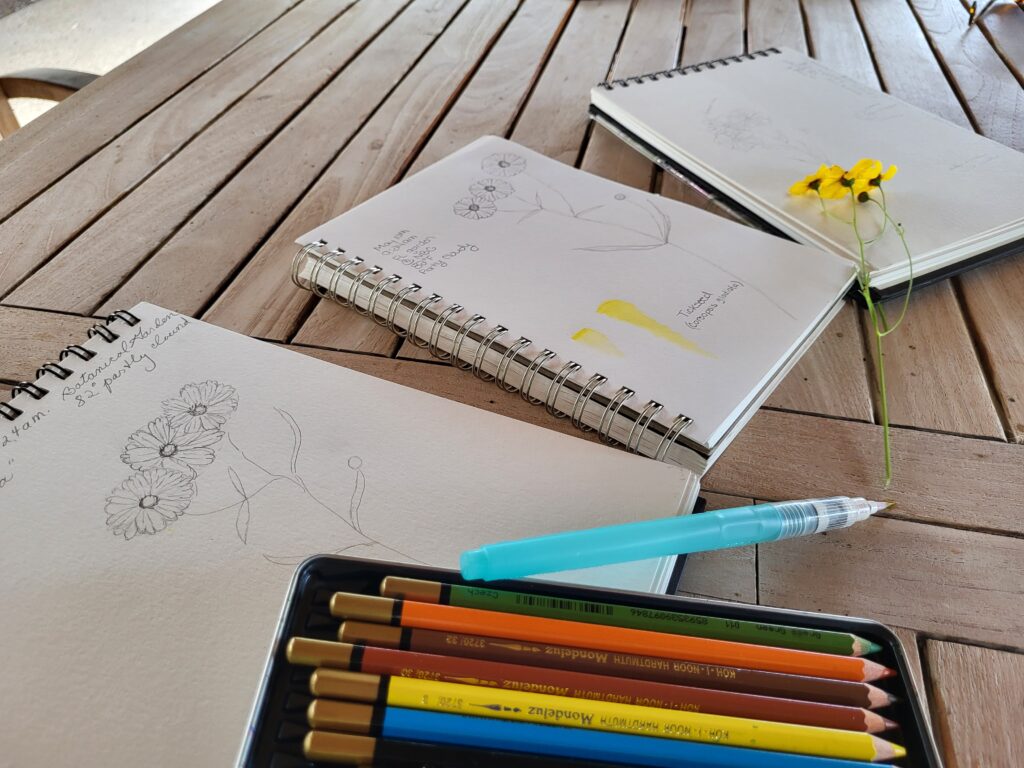
“I believe that in the natural spaces you find more surprises like birds, insects, movement—is that a snake?” says Karen Baldwin, another student. “More of the whole picture of nature’s interplay comes into what you are seeing.”
She enjoys journaling in designed gardens, too, though she finds fewer “surprises” in a managed landscape.
Venturing into the Preserve can be intimidating, especially to those who are not familiar with Florida’s many plant and animal species. It raises curiosities like: Could that thicket of saw palmetto (Serenoa repens) be concealing a panther, or could that fallen slash pine (Pinus elliottii var. densa) be the lair of a rattlesnake? Tobin says her senses are heightened while exploring the Preserve.
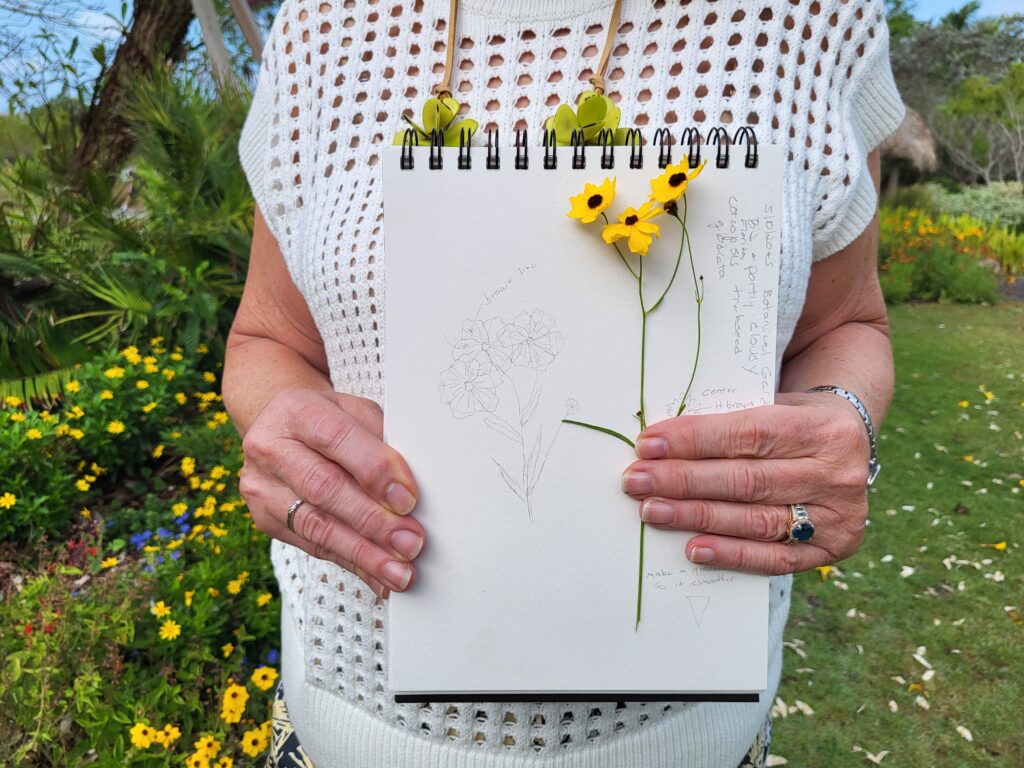
“I felt a little more relaxed in the cultivated gardens than in the Preserve,” she explains. “Things were more orderly in the cultivated gardens. The Preserve felt wilder. I think I was more aware of my surroundings wondering if an alligator may appear!”
As educators, we hope these artistic experiences help people feel more at ease in the Florida wilderness and, ultimately, encourage more actions toward its protection. Simple steps like landscaping with native plants, volunteering for local conservation-based organizations, and voting for environment-minded candidates can make a difference.
Enticing people to observe nature more intently, as done in Nature Journaling, is a superb way to open people’s hearts to Florida’s natural charm. As an instructor, watching this come to fruition is a fulfilling experience.
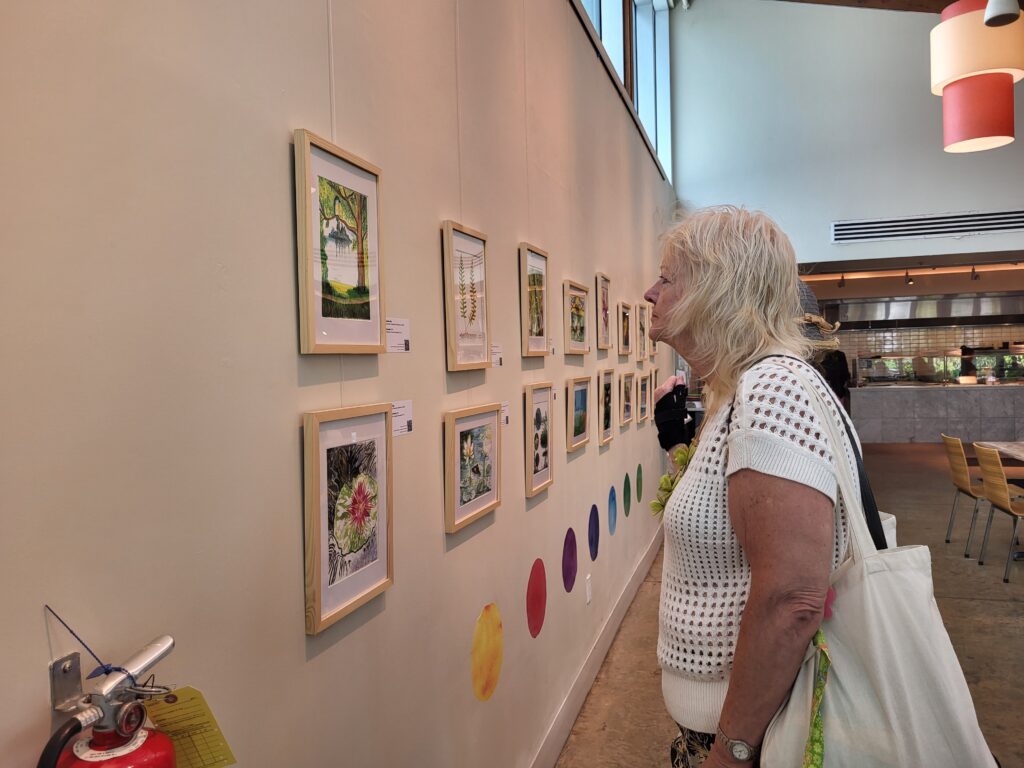
About Nature Journaling
We offer two Nature Journaling programs.
The first is an eight-week, virtual creative aging course for people aged 55 and older. Led by a Garden educator, students receive a complimentary nature journaling kit with all the tools they need to let their artistic side run free. Occasional class “meet-ups” are scheduled, allowing those in the Naples area to venture out of the virtual classroom and into the Garden. This course is offered once yearly in the spring at no charge.
We also offer 90-minute, in-person workshops for anyone aged 16 and older. Fees include materials.
This article first appeared in the 2025 issue of Conserve, the Garden’s conservation magazine.